
 ultimate-guide
Commercial Painting During Business Hours: A Complete Guide
Table of Contents
- Can Your Business Stay Open During Commercial Painting?
- Benefits of After-Hours and Off-Peak Scheduling
- Minimizing Business Disruption During Painting Projects
- Commercial Painting Project Timeline: What to Expect
- Low-VOC Paint for Commercial Spaces: Air Quality and Safety
- Preparing Your Workspace and Managing Site Access
- Legal and Insurance Considerations for After-Hours Access
- Frequently Asked Questions
Last Updated: September 25, 2026
Can Your Business Stay Open During Commercial Painting?
The short answer is yes, but execution matters. With proper planning, the right contractor, and clear communication, your business can remain operational while your space transforms. Commercial painting during business hours requires coordinating access, managing safety hazards, controlling dust and odors, and preserving customer and employee experiences. Success depends on preparation, not luck.
Benefits of After-Hours and Off-Peak Scheduling
Off-peak scheduling eliminates operational headaches. When crews work after hours or weekends, disruption drops dramatically. Painters gain uninterrupted access to move equipment and apply coatings without stopping for foot traffic. This efficiency accelerates project completion, a three-week job during operating hours often finishes in one or two weeks when the facility is closed.
Safety improves significantly. High-traffic areas remain off-limits to staff and customers during active painting, eliminating tripping hazards and VOC exposure risks. Air quality management becomes simpler; ventilation systems run continuously without concern for occupied spaces, allowing proper curing before employees return.
Cost considerations vary. Off-peak scheduling sometimes costs less due to uninterrupted work efficiency, though weekend and overnight premiums may apply. The real savings come from avoiding operational disruption, lost productivity, and customer experience issues.
Minimizing Business Disruption During Painting Projects
If your business must remain open, minimizing disruption becomes central. Start with a detailed site walk-through at least two weeks before work begins. Always Pro Painters conducts these with facility managers to identify high-traffic areas, sensitive equipment, and operational bottlenecks. Mark zones that must remain accessible and photograph existing conditions.
Phased project execution is essential.
Commercial Painting Project Timeline: What to Expect
Commercial painting timelines depend on scope, facility complexity, and scheduling approach. Surface preparation takes 30-50% of total time and includes cleaning, patching drywall, sanding, and priming. Actual painting application takes 20-30% of time. Curing and final details consume 15-25% of time.
Low-VOC Paint for Commercial Spaces: Air Quality and Safety
Volatile organic compounds (VOCs) are chemicals that evaporate from paint during application and curing. In enclosed commercial spaces, VOC concentration affects air quality and occupant health. Understanding VOC behavior and safe-to-occupy timelines is critical for businesses that cannot close during painting.
How VOCs Affect Commercial Spaces
Traditional paints release high levels of VOCs during application and for days afterward. Low-VOC formulations contain fewer chemicals, resulting in lower indoor air quality impact.
VOC Emission Timeline:
- High-VOC paints: Peak emissions occur during application and the first 24-48 hours. Elevated air quality persists for 7-14 days. Occupants may experience headaches, respiratory irritation, and difficulty concentrating.
- Low-VOC paints: Peak emissions occur during application and the first 12-24 hours. Most off-gassing completes within 48-72 hours. Residual odor may persist for 3-7 days but VOC concentrations typically return to baseline within 48-72 hours.
- Zero-VOC paints: These products contain minimal VOCs. Off-gassing is minimal, though some odor may persist for 24-48 hours.
Safe-to-Occupy Timeline and Air Quality Recovery
Low-VOC Paint Safe-to-Occupy Guidelines:
- 0-4 hours: Space should remain unoccupied. Ventilation systems should run on maximum.
- 4-24 hours: Space can accommodate limited occupancy if ventilation is continuous and windows are open. Sensitive individuals should avoid the space.
- 24-48 hours: Space is generally safe for normal occupancy with standard ventilation. Continue running HVAC systems on maximum during business hours.
- 48-72 hours: Space has returned to baseline air quality for most low-VOC products.
High-VOC Paint Safe-to-Occupy Guidelines:
- 0-24 hours: Space should remain unoccupied.
- 24-72 hours: Limited occupancy only with maximum ventilation and open windows.
- 72 hours to 2 weeks: Space can accommodate normal occupancy, but ventilation should remain elevated.
These timelines assume adequate ventilation. Poorly ventilated spaces take significantly longer to recover.
Ventilation Strategy During and After Painting
Ventilation is the primary mechanism for removing VOCs from a painted space.
During Painting:
- Run HVAC systems on maximum capacity
- Open all windows in the painted area if weather permits
- Use portable air scrubbers with HEPA and activated carbon filters in adjacent occupied areas
- Ensure HVAC returns are not blocked by plastic sheeting or equipment
Immediately After Painting (0-24 hours):
- Continue running HVAC systems on maximum
- Keep windows open if weather permits
- Do not close off the painted space, air circulation is critical for off-gassing
- Avoid using the space for meetings requiring concentration
24-72 Hours After Painting:
- Maintain elevated HVAC operation during business hours
- Continue open windows during daytime if weather permits
- For spaces with sensitive equipment or vulnerable occupants, extend elevated ventilation to 1 week
After 72 Hours:
- Return HVAC systems to normal operation
Choosing the Right Paint Type for Your Facility
Given the operational benefits and health considerations, most facility managers find the investment worthwhile, particularly for commercial painting during business hours.
Low-VOC Paint Advantages:
- Faster safe-to-occupy timeline (48-72 hours vs. 7-14 days)
- Reduced employee health symptoms during and after painting
- Lower risk of customer complaints about odor
- Better for facilities with sensitive equipment
Monitoring Air Quality During Recovery
For facilities with sensitive operations or vulnerable occupants, consider monitoring air quality during recovery using VOC meters, CO₂ monitors, or humidity monitors. Establish a baseline measurement before painting begins and take measurements at 24, 48, and 72 hours after painting.
Special Considerations for Specific Facility Types
Medical Offices and Healthcare Facilities: Patients and staff with respiratory conditions are more sensitive to VOCs. Use zero-VOC or low-VOC paint exclusively. Extend safe-to-occupy timelines by 24-48 hours beyond standard guidelines.
Preparing Your Workspace and Managing Site Access
Workspace preparation determines whether your facility stays functional during painting.
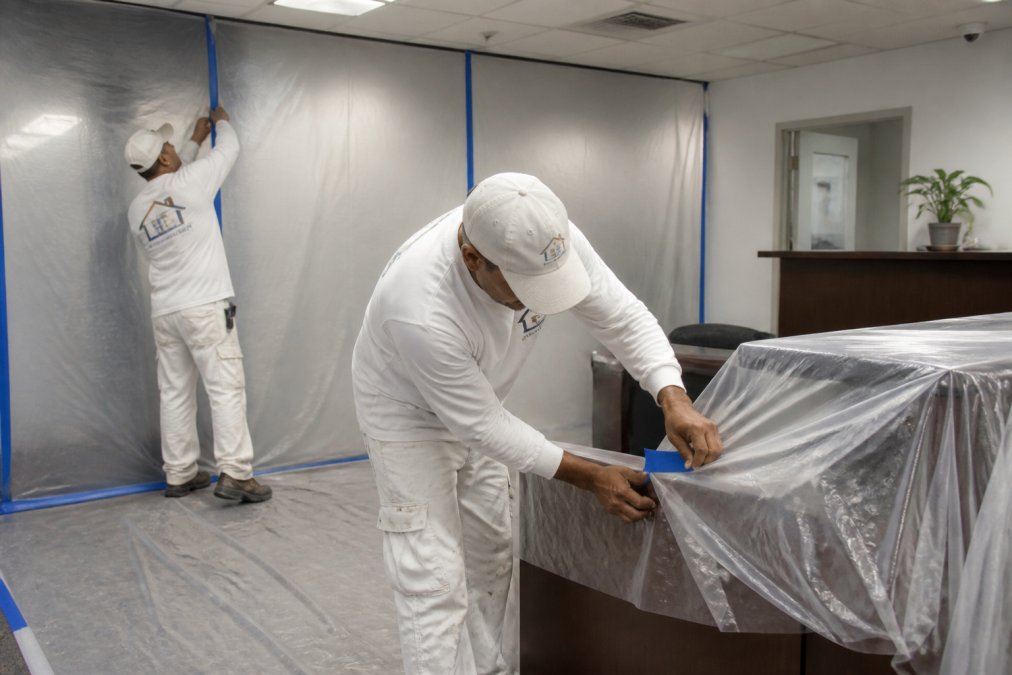
Pre-Painting Facility Manager Checklist
Create a detailed preparation checklist at least two weeks before crews arrive:
Furniture and Equipment Removal:
- Document all items with photos before moving
- Remove or relocate items to secure storage off-site
- Identify which furniture pieces require protective covering versus removal
- Coordinate with department heads on temporary workspace relocations
Sensitive Equipment Protection:
- Identify all IT infrastructure: servers, network switches, patch panels, routers, and telecommunications equipment
- Document exact locations and create a floor plan marking these zones as "no-paint" areas
- Discuss with the contractor whether these areas require sealed containment barriers
- Protect copiers, printers, and other office equipment with plastic sheeting secured at all edges
- For climate-controlled server rooms, confirm these remain sealed during painting
Access Control and Security:
- Create a written access log documenting contractor personnel with keys or security codes
- Specify exact dates and times when access is authorized
- Establish a protocol for after-hours access
- Brief security personnel on expected contractor arrival and departure times
- Designate one facility staff member as the primary contact
Ventilation and Air Quality Setup:
- Verify HVAC system functionality before painting begins
- Identify which ventilation zones serve occupied versus active painting areas
- Arrange for HVAC systems to run on maximum during and for 24 hours after painting
- If your facility uses portable air purifiers, position them in occupied areas during active painting
Parking and Material Staging:
- Confirm parking availability for contractor vehicles (typically 2-4 spaces)
- Designate a material staging area away from high-traffic employee zones
- Verify that paint deliveries can be accommodated without blocking loading docks or emergency exits
Communication and Signage:
- Create a project schedule poster for common areas
- Prepare daily email templates for staff updates
- Brief customer-facing teams on how to explain temporary inconveniences
- Post wet paint signage at all entry points to active work areas
- Use floor tape to mark boundaries between work zones and operational areas
Coordination with Painters:
- Conduct a formal site walk-through with the painting contractor at least one week before work begins
- Photograph and document existing wall conditions and any pre-existing damage
- Provide the contractor with a marked floor plan showing sensitive equipment locations and off-limits areas
- Discuss the contractor's containment strategy
- Confirm the contractor's plan for protecting HVAC returns, light fixtures, and electrical outlets
- Establish daily start and end times aligned with your operational schedule
- Agree on a protocol for addressing unexpected issues
Managing Sensitive Equipment During Painting
Server Rooms and Network Closets: These should remain completely sealed during painting. Discuss with the contractor whether these spaces require negative pressure containment or simply closed doors with weatherstripping. Confirm that the contractor will seal all penetrations connecting the equipment room to the painting zone.
Establishing Clear Boundaries
Use temporary barriers, plastic sheeting, and wet paint signage to define where painters are working. Brief all staff on these boundaries before crews arrive. Establish a protocol: if an employee must access a painting zone for an emergency, they must notify the contractor first and follow any required safety procedures.
Documentation and Handoff
Before the contractor begins work, provide them with a written facility profile that includes emergency contact information, location of electrical panels and HVAC equipment, areas that are permanently off-limits, parking and material staging instructions, after-hours access procedures, and expected timeline for each phase.
Legal and Insurance Considerations for After-Hours Access
After-hours access introduces liability considerations that facility managers often overlook.
Frequently Asked Questions
Can a business stay open during commercial painting?
Yes, but it requires careful planning. Many businesses operate during painting projects by using phased scheduling, off-peak hours, or specific zones. The key is coordinating with your painting contractor to establish clear access protocols, dust containment, and communication with staff and customers. After-hours or weekend painting eliminates disruption entirely but costs more. During-hours painting works best for businesses with flexible operations or those that can adjust customer-facing areas temporarily.
What is the typical commercial painting project timeline?
Always request a detailed timeline from your contractor that accounts for surface prep, primer, paint coats, and curing time before full occupancy resumes.
How do low-VOC paints help with air quality in commercial spaces?
Low-VOC (volatile organic compound) paints release fewer harmful chemicals during and after application, reducing odor and improving indoor air quality for employees and customers. Standard paints can off-gas for weeks; low-VOC formulations typically off-gas for 3-7 days. For commercial spaces, low-VOC paints allow faster return to normal operations, reduce ventilation requirements, and support healthier indoor environments. They eliminate productivity losses from odor-related complaints and health concerns.
What should I do to prepare my workspace before painters arrive?
Conduct a site walk-through with your contractor to identify high-traffic areas, sensitive equipment, and IT infrastructure that needs protection. Remove or relocate furniture and personal items from painted areas. Ensure painters have clear access and adequate ventilation. Notify staff of the schedule and establish protocols for dust containment and wet paint signage. Protect computers, printers, and other electronics with plastic sheeting. Secure confidential documents and valuables. Confirm parking, entry access, and any after-hours security requirements with your contractor beforehand.