 how-to
Surface Preparation for Commercial Coatings: A Step-by-Step Guide
Table of Contents
- Why Surface Preparation Matters for Commercial Coatings
- Step 1: Surface Cleaning and Decontamination
- Step 2: Mechanical Abrasion and Blasting Techniques
- Step 3: Moisture Mitigation and Vapor Barriers
- Industrial Floor Coating Preparation Standards
- OSHA Floor Marking Requirements for Businesses
- Commercial Epoxy Floor Maintenance Guide
- Adhesion Testing and Quality Control
- Frequently Asked Questions
Last Updated: October 3, 2026
Why Surface Preparation Matters for Commercial Coatings
Surface preparation commercial projects are the foundation of every successful coating application for property owners. Skip this step, and even the best paint fails. The finish won't stick properly, durability suffers, and you'll be repainting in months instead of years.
A properly prepared substrate ensures adhesion, extends coating life, and delivers the clean lines and solid finish that commercial spaces demand.
Step 1: Surface Cleaning and Decontamination
Remove dust, dirt, oils, grease, and loose debris that prevent coating adhesion.
Begin with a thorough cleaning using appropriate methods for your substrate:
- Pressure washing for exterior surfaces and heavily soiled concrete
- Degreasing for floors with oil or chemical residue
- Dust removal with HEPA-filtered vacuum systems to avoid spreading particles
- Chemical cleaning for specialized contaminants or stains
Allow surfaces to dry completely and use moisture testing to confirm readiness before coating application.
Step 2: Mechanical Abrasion and Blasting Techniques
Mechanical abrasion creates the micro-texture needed for coating adhesion. The abrasion method impacts both upfront costs and long-term durability, especially in freeze-thaw climates with road salt exposure.
Shot Blasting for Concrete Profiling
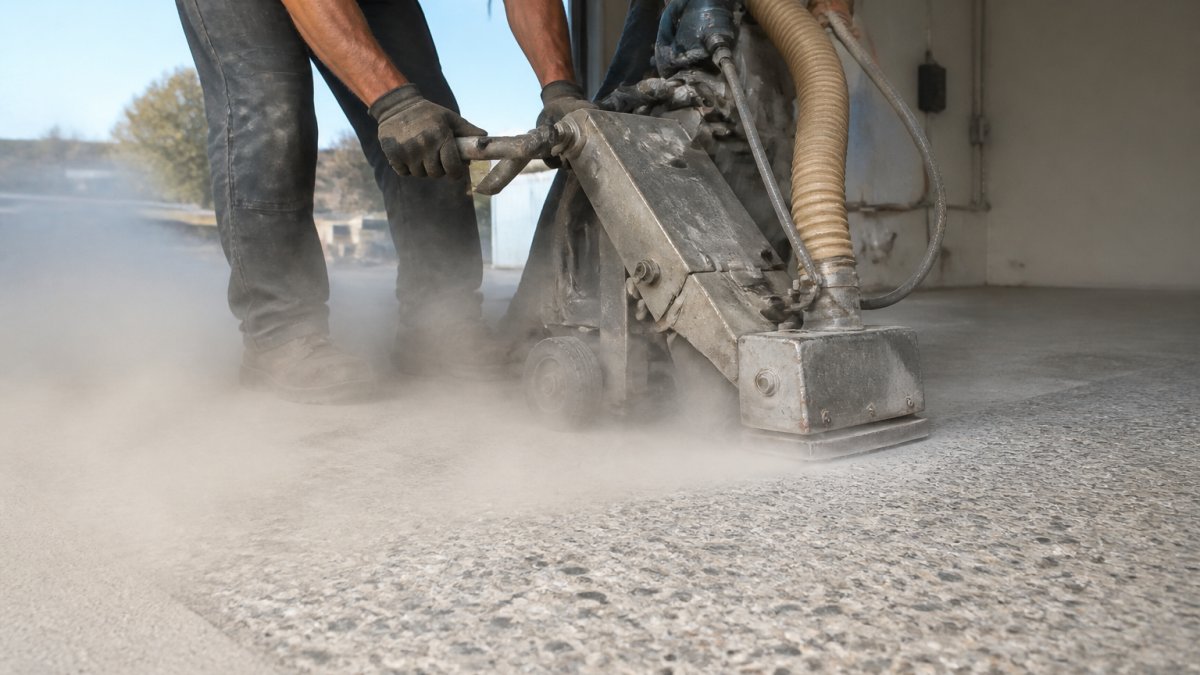
Shot blasting propels steel pellets to remove the concrete top layer and create surface profile, the gold standard for high-traffic commercial spaces with chemical or moisture exposure.
Shot blasting removes old coatings, surface laitance, and embedded contaminants while creating consistent ASTM D3276 CSP 2-3 profile texture.
Proper containment and HEPA filtration manage dust; off-hours scheduling minimizes facility disruption.
Shot blasting removes deeper contaminants and creates aggressive profile. For salt-exposure areas, this translates to better adhesion and longer coating life.
Diamond Grinding for Smooth Substrates
Diamond grinding uses rotating diamond heads to smooth and profile concrete simultaneously, working best for existing coating removal or specific finish profiles.
Diamond grinding offers lower dust generation and precise profile control, ideal for occupied facilities with dust control requirements.
Diamond grinding suits lower-traffic facilities but creates shallower profile (ASTM D3276 CSP 1-2), potentially reducing coating life 20-30% in high-traffic or salt-exposed areas. Cost savings justify the trade-off for controlled office environments.
Climate Considerations: Freeze-Thaw and Salt Exposure
Freeze-thaw cycles and road salt tracking compromise concrete substrates near building entrances, loading docks, and parking areas before coating application begins.
In high-exposure zones, shot blasting is strongly recommended to remove salt-damaged layers and create maximum adhesion. Moisture testing is critical; salt-contaminated concrete retains higher moisture levels.
Diamond grinding in salt-exposure areas often results in coating failure, offsetting initial savings with premature recoating costs.
Choosing the Right Method for Your Facility
Assess your specific situation:
Choose shot blasting if:
- Your facility is in a high-traffic zone with road salt exposure
- The concrete shows signs of spalling, scaling, or freeze-thaw damage
- You need maximum coating durability (10+ years)
- The facility is a warehouse, manufacturing space, or commercial kitchen
- Budget allows for premium preparation to protect a significant coating investment
Choose diamond grinding if:
- Your facility is climate-controlled with minimal salt exposure
- Traffic volume is moderate and contaminant levels are low
- You need to minimize downtime and dust in an occupied space
- Budget is constrained and the coating system is designed for moderate-traffic use
- The substrate is in good condition with no signs of freeze-thaw damage
Step 3: Moisture Mitigation and Vapor Barriers
Moisture is the silent killer of commercial coatings. Concrete wicks moisture upward, causing blistering, peeling, and failure if coatings aren't designed to handle it.
Moisture vapor transmission (MVT) testing determines moisture levels and guides coating selection and moisture barrier needs.
Consider moisture barriers, epoxy primers formulated for higher moisture tolerance, or urethane cement systems for damp substrates.
Industrial Floor Coating Preparation Standards
Surface preparation commercial flooring requires preparation meeting industry standards for epoxy applications.
Key preparation standards include:
- ASTM D3276 for concrete surface profile specification
- ASTM D4417 for measurement of surface profile
- ASTM F2170 for moisture vapor transmission testing
- ASTM D4262 for pH testing of concrete surfaces
These standards ensure consistency and performance, guaranteeing clean lines and solid finishes.
A coating can only perform as well as the surface beneath it.
OSHA Floor Marking Requirements for Businesses
Commercial facilities must comply with OSHA floor marking requirements to protect workers and create organized, safe spaces.
OSHA standards require floor marking for:
- Hazardous areas and equipment
- Emergency exits and evacuation routes
- Storage areas and work zones
- Electrical hazards and confined spaces
Floor marking must be visible, durable, and properly maintained. When you prepare a commercial floor for coating, integrate marking requirements into your design. High-quality epoxy or polyurethane coatings can incorporate safety markings that last years without fading or peeling.
Commercial Epoxy Floor Maintenance Guide
A properly prepared and coated commercial floor requires ongoing maintenance to extend its life. Maintenance demands vary based on facility type, traffic volume, and climate exposure.
MaintenanceSchedules for high-traffic zones should include:
- Daily cleaning with pH-neutral cleaners to remove dirt and debris (critical in salt-exposure zones where road salt must be removed before it migrates into the coating)
- Weekly deep cleaning in high-traffic areas using appropriate equipment (avoid harsh chemicals that can degrade epoxy; use cleaners with VOC content below 50 g/L to maintain indoor air quality)
- Monthly inspection for signs of wear, damage, coating degradation, or salt residue buildup
- Quarterly assessment of floor marking visibility and compliance
- Semi-annual deep cleaning in freeze-thaw zones to remove salt deposits and prevent substrate damage beneath the coating
- Annual maintenance including resealing or touch-up coating as needed
Climate-Specific Maintenance Demands
Epoxy flooring in commercial kitchens, warehouses, or retail spaces experiences constant stress. However, facilities in freeze-thaw climates face additional challenges that standard maintenance guides don't address.
Salt tracking and freeze-thaw stress: Road salt tracked indoors accelerates coating degradation if not managed. Salt crystals absorb moisture and create osmotic pressure beneath the coating, causing blistering and peeling. In high-exposure zones (building entrances, loading docks, parking areas), implement these additional steps:
- Remove salt residue within 24 hours of entry using pH-neutral cleaners formulated for salt removal
- Increase cleaning frequency during winter months when salt tracking is highest
- Monitor for white salt deposits or crystallization on the coating surface; these indicate moisture and salt migration
- Consider installing entrance mats or grates to minimize salt tracking into critical areas
Humidity and moisture management: Seasonal humidity swings can cause moisture vapor transmission through coatings, especially in facilities without climate control. In spring and fall when humidity fluctuates rapidly:
- Increase ventilation to prevent moisture accumulation
- Monitor for signs of blistering or soft spots in the coating
- Avoid wet-cleaning methods during high-humidity periods; use dry cleaning instead
- If moisture issues develop, professional resealing may be needed before the problem spreads
VOC Compliance and Sustainable Maintenance
Commercial property owners increasingly face pressure to meet green building standards (LEED, WELL, or local sustainability ordinances). Your maintenance approach directly impacts indoor air quality and VOC emissions.
Maintenance product selection matters: Standard industrial cleaners often contain high VOC levels (200+ g/L). Switching to low-VOC maintenance products (under 50 g/L) reduces indoor air quality degradation and worker exposure. Many facilities find that low-VOC cleaners perform equally well while supporting sustainability goals.
Approved maintenance products for epoxy floors:
- pH-neutral, low-VOC floor cleaners (check product data sheets for VOC content)
- Water-based degreasers for oil or chemical residue
- Microfiber mop systems to reduce water and chemical use
- Avoid solvent-based strippers or harsh chemicals that can soften epoxy
Documentation for compliance: If your facility is pursuing LEED certification or other green building credentials, maintain records of:
- Cleaning product VOC content and usage
- Maintenance schedules and activities
- Any resealing or touch-up work performed
This documentation demonstrates commitment to indoor environmental quality and can support certification applications.
Maintenance Frequency by Facility Type
Epoxy flooring in different commercial environments requires different maintenance intensity:
Retail and customer-facing spaces: Daily foot traffic and exposure to tracked contaminants require daily cleaning and weekly deep cleaning. High-traffic zones near entrances need additional attention to salt and moisture removal.
Warehouses and manufacturing: Heavy equipment traffic and potential chemical spills demand daily inspection and immediate cleanup of spills. Weekly deep cleaning with appropriate degreasers is essential. In freeze-thaw zones, monthly salt residue removal is critical.
Commercial kitchens and food service: Daily cleaning with food-safe, low-VOC cleaners is mandatory. Weekly deep cleaning with degreasing products rated for food service areas. Monthly inspection for signs of moisture or coating degradation.
Office and administrative spaces: Lower traffic allows for less frequent maintenance. Daily light cleaning and weekly deep cleaning are typically sufficient. Monthly inspection is adequate unless the space has high moisture exposure.
Warning Signs That Professional Maintenance Is Needed
While routine cleaning extends coating life, certain conditions require professional intervention:
- Blistering or soft spots: Indicates moisture migration; professional moisture testing and possible resealing needed
- Peeling or delamination: Suggests adhesion failure; the affected area must be removed and recoated
- Visible cracks or spalling: Substrate damage beneath the coating; professional assessment required before further deterioration spreads
- Persistent staining or discoloration: May indicate chemical penetration or salt accumulation; professional cleaning or resealing may be necessary
- Loss of slip resistance: Coating wear in high-traffic zones; professional resealing or overlay coating needed
Early detection of problems prevents expensive failures and extends coating life significantly.
Adhesion Testing and Quality Control
Before full coating application, adhesion testing confirms that your prepared surface is ready. This step prevents expensive failures later.
Common adhesion tests include:
- Pull-off adhesion testing to measure coating bond strength
- Cross-hatch adhesion testing to assess coating adhesion to substrate
- Visual inspection for surface defects, contamination, or improper profile
- Moisture vapor transmission testing to confirm substrate readiness
These tests are non-negotiable for commercial applications. They provide documented proof that preparation meets specifications and that your coating investment is protected.
Quality control during preparation prevents costly rework. Professional contractors like Always Pro Painters perform these tests as standard practice. We document results and adjust preparation methods if any issues are identified.
When you invest in commercial coatings, you're protecting that investment through rigorous preparation and testing. This is how we guarantee clean lines and solid finishes without taking shortcuts.
Surface preparation for commercial property owners isn't glamorous, but it's absolutely critical. The difference between a coating that fails in months and one that performs for over a decade starts here.
Frequently Asked Questions
What are the NACE standards for surface preparation?
NACE (National Association of Corrosion Engineers) standards define surface cleanliness levels for coating application. NACE SP0170 outlines blast cleaning standards, ranging from NACE 1 (light blast cleaning) to NACE 3 (high-velocity oxy-fuel cleaning). For commercial epoxy flooring, NACE SP0170 compliance ensures substrate adhesion and coating longevity. Always verify which NACE level your coating manufacturer requires before beginning surface preparation work.
Why is mechanical surface preparation critical for high-traffic epoxy coatings?
Mechanical abrasion creates surface porosity and texture that allows epoxy coatings to bond at a molecular level. Without proper mechanical preparation, coatings sit on top of the substrate rather than adhering to it, leading to peeling, flaking, and premature failure in high-traffic zones. Shot blasting and diamond grinding remove contaminants, old coatings, and weak surface layers, establishing the substrate integrity needed for coating longevity and abrasion resistance.
How does moisture affect epoxy floor coating performance?
Moisture vapor transmission (MVT) from concrete causes coating failure, blistering, and delamination. Concrete below grade or in humid environments absorbs groundwater, releasing vapor during curing and application. Moisture mitigation involves testing MVT rates with calcium chloride tests, installing vapor barriers, and allowing adequate drying time before primer application. High-traffic commercial spaces require vapor barrier systems rated for the specific moisture conditions of your facility.
What surface preparation is needed before epoxy primer application?
After mechanical abrasion, the substrate must be clean, dry, and free of dust and contaminants. Vacuum all debris thoroughly, then wipe surfaces with a damp cloth to capture fine particles. Allow the surface to dry completely (typically 24 hours in normal conditions). Verify substrate moisture levels meet coating manufacturer specifications, usually below 85% relative humidity. Only after these steps should you apply primer to ensure proper topcoat performance and durability.