 how-to
How to Calculate Interior Painting Cost Per Square Foot
Table of Contents
- Start With Paintable Wall Area, Not Floor Area
- How to Calculate Wall Square Footage for Painting
- The Cost Per Square Foot Formula, Step by Step
- Try an Interior Painting Cost Calculator Before You Commit
- What It Costs to Paint a Room: Walls, Ceilings, Trim, and Doors
- Factors Affecting Interior Painting Costs
- Conclusion
- Frequently Asked Questions
Last Updated: October 7, 2026
Start With Paintable Wall Area, Not Floor Area
Most homeowners estimate interior painting cost by looking at the square footage on their property listing. That number tells you nothing useful about what a painter will actually charge. Floor area measures the ground you walk on. Painters charge for paintable area: the walls, ceilings, trim, and doors that actually get coated.
A 1,200-square-foot condo can carry more paintable wall area than a 1,500-square-foot house if the condo has more rooms, more corners, and more trim. That gap is why two neighbors with similar floor plans often get very different quotes.
At Always Pro Painters, we see this confusion on nearly every estimate call. Homeowners compare a quote to their home's listed square footage, assume something is off, and start shopping around. The real issue is that floor area and paintable area are two different measurements.
So before you calculate interior painting cost per square foot, you need the right number to divide by. Here's how to find it.
How to Calculate Wall Square Footage for Painting
Wall square footage for painting is the total surface area of your interior walls, minus doors and windows. You measure each wall's length and height, multiply them together, then add every wall in the room.
The U.S. General Services Administration's facilities standards treats paintable wall area as a distinct measurement from floor area for exactly this reason: the two numbers rarely match, and the gap can be large.
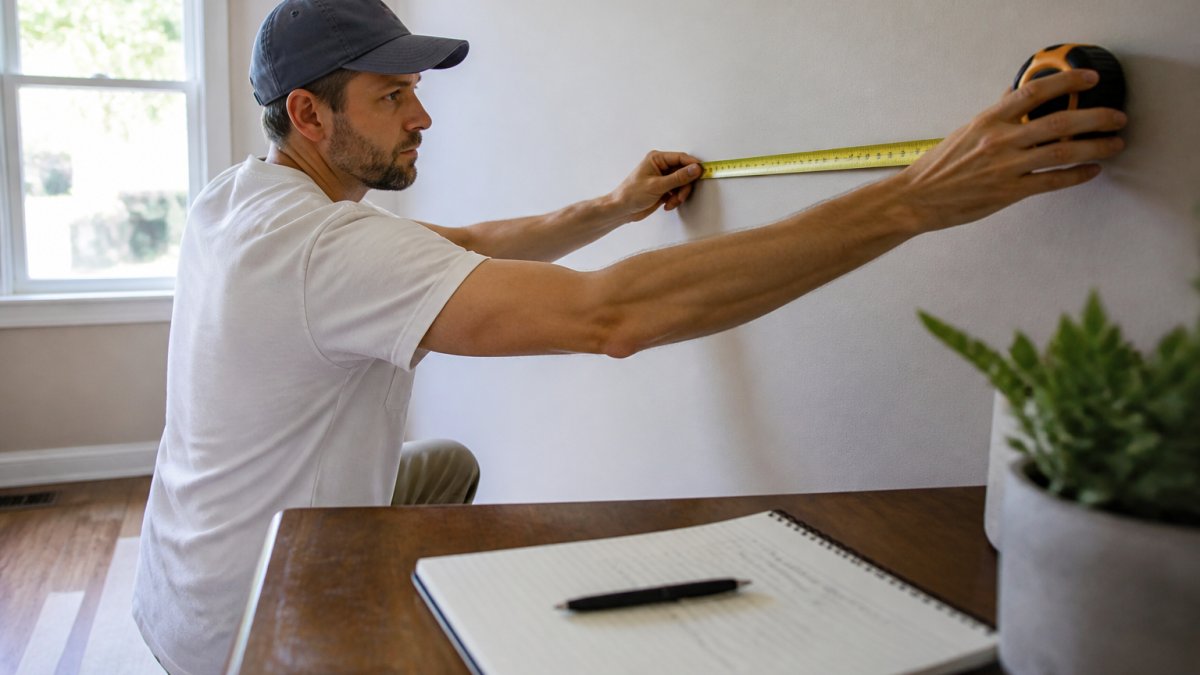
Here's the basic process:
- Measure the length of each wall in feet
- Measure the ceiling height in feet
- Multiply length times width for each wall
- Add all walls together for gross wall area
- Subtract doors and windows from the total
A standard door is roughly 20 square feet. A standard window is roughly 15 square feet. Subtract those from your gross wall area to get net paintable area.
The Cost Per Square Foot Formula, Step by Step
The formula for interior painting cost per square foot is simple: total project cost divided by total paintable square footage. The hard part is getting both numbers right. Walk through it once with real numbers and the whole process clicks.
Step 1: Measure Each Wall's Length and Height
Walk the room with a tape measure and a notepad. Write down the length of each wall and the ceiling height. Do this room by room, not from memory.
Total time: 15-20 minutes for a typical three-bedroom home.
Expected result: A room-by-room list of wall lengths and heights.
Step 2: Subtract Doors and Windows, Then Multiply by Coats
Subtract the square footage of doors and windows from your gross wall area. Then multiply by the number of coats you need.
Two coats is standard for most interior work. If you're covering a dark color with a light one, or painting over fresh drywall, plan for three.
Step 3: Divide the Total Bid by Total Paintable Area
This is the number that matters. Take the painter's total bid and divide it by your net paintable square footage. That gives you the true square-foot rate.
A Worked Example: One 12 x 15 Bedroom
Say you're pricing a single bedroom that measures 12 feet by 15 feet with 8-foot ceilings. Here's the full calculation, start to finish.
Gross wall area. The room has two 12-foot walls and two 15-foot walls. Add them: 12 + 12 + 15 + 15 = 54 linear feet of wall. Multiply by the 8-foot ceiling height: 54 x 8 = 432 square feet of gross wall area.
Deduct openings. The room has one standard door (about 20 square feet) and two standard windows (about 15 square feet each, so 30). Total deductions: 20 + 30 = 50 square feet. Net wall area: 432 - 50 = 382 square feet.
Add the ceiling. The ceiling is 12 x 15 = 180 square feet. If you're painting it too, add it in: 382 + 180 = 562 square feet of paintable surface.
Multiply by coats. Two coats on the walls and ceiling: 562 x 2 = 1,124 square feet of actual coating work. This is the number that drives both labor and material.
Apply a rate. Suppose the painter quotes a rate of $1.50 per square foot of paintable area (walls and ceiling, two coats). Multiply: 562 x $1.50 = $843 for that room.
Check the trim separately. Baseboards, door casing, and window trim are usually priced per linear foot, not per square foot. Measure the perimeter of the room (54 linear feet of wall) and add the trim around each opening.
That's the whole method. Every quote you receive can be reverse-engineered the same way: total bid divided by net paintable area equals the rate you're actually paying.
| What You're Measuring | How to Get It | Why It Matters |
|---|---|---|
| Gross wall area | Length x height, all walls | Starting point before deductions |
| Net paintable area | Gross area minus doors and windows | The number painters quote against |
| Coats needed | 2 standard, 3 for color changes | Multiplies your paint and labor |
| Square-foot rate | Total bid ÷ net paintable area | Lets you compare quotes fairly |
Try an Interior Painting Cost Calculator Before You Commit
An interior painting cost calculator gives you a ballpark before you call anyone. Most let you enter room dimensions, ceiling height, and number of coats, then return a rough range.
Use one as a sanity check, not a final number. Every calculator makes assumptions about prep work, trim, and access that may not match your home.
A few things most calculators leave out:
- Drywall repairs and patching
- Sanding and surface preparation
- Trim, doors, and cabinet refinishing
- Furniture moving and masking
- Ceiling height above standard
What It Costs to Paint a Room: Walls, Ceilings, Trim, and Doors
Each surface carries its own price, and mixing them into one square-foot rate is the fastest way to misread a quote. Walls are the cheapest per square foot because they have the fewest edges. Ceilings cost more because of the overhead work.
Walls, priced per square foot of paintable area. This is the rate most people mean when they say "cost per square foot." It covers rolling the field of the wall, cut-in at corners and ceilings, and two coats. It does not usually include trim, doors, or ceilings unless the quote says so.
Ceilings, priced per square foot, usually higher than walls. Overhead work is slower, requires more ladder or scaffold time, and drips are harder to control. Expect the ceiling rate to run above the wall rate for the same square footage.
Trim, priced per linear foot. Baseboards, crown molding, door casing, and window trim are measured along their length, not their face area. A room with 54 linear feet of wall might carry 54 linear feet of baseboard plus casing around every door and window. Linear-foot pricing reflects the cut-in, taping, and brushwork each foot requires.
Doors, priced per door, often per side. A standard slab or panel door is quoted as a unit. Painting both sides and the edges typically costs more than one side. A door with panels takes longer than a flat slab because of the recessed detail.
Cabinets, priced per door and drawer front. Cabinet refinishing is quoted by the piece, not by the room, because each front must be removed, cleaned, sanded, primed, and sprayed or brushed. This is the most labor-intensive surface in a typical interior job.
Why the Same Room Can Quote Two Different Ways
A painter who prices by wall square footage only will give you a lower number than one who itemizes walls, ceilings, trim, and doors. Neither is wrong, but they cover different scopes. When you compare bids, check which surfaces are included and which are billed separately. A quote that looks cheaper per square foot may simply be leaving trim and ceilings off the line items.
The U.S. Environmental Protection Agency's guidance on lead-safe renovation matters here. Homes built before 1978 may require lead-safe work practices, which add prep time and cost on every surface, walls, trim, and doors alike. Always ask a contractor how they handle older homes.
Factors Affecting Interior Painting Costs
Several variables move the final number more than most homeowners expect. Understanding them helps you read a quote accurately instead of comparing apples to oranges.
Surface condition is the biggest swing factor. A wall in good shape needs light prep. A wall with cracks, holes, or peeling paint needs patching, sanding, and priming first.
Access and complexity matter too. Tall ceilings, tight stairwells, and lots of trim slow a crew down. So does furniture that has to be moved and protected.
Labor rates vary by market and season. U.S. Bureau of Labor Statistics data on painter wages shows how much painter pay varies across regions, which feeds directly into what you're quoted.
Paint quality changes the material line. Higher-grade paint covers better and lasts longer, but costs more per gallon.
Conclusion
Getting a fair price starts with knowing your paintable square footage, not your floor plan. Measure the walls, subtract doors and windows, multiply by coats, then divide the bid by that number. Now you can compare quotes on equal footing.
If the math feels like more work than it's worth, that's exactly the kind of thing we handle. Always Pro Painters delivers a clean foundation for paint through detailed surface preparation, guarantees clean lines and a solid finish without shortcuts, and closes every job with a final walkthrough to make sure the result meets your expectations.
Get started with Always Pro Painters and a free estimate built around the finish, not the rush.
Frequently Asked Questions
How do you calculate the square footage for an interior painting estimate?
Measure the length of each wall and multiply it by the wall height to get square footage. Add the ceiling area by multiplying room length times width. Subtract about 15 to 20 square feet for each door and 10 to 15 square feet for each window. The result is your paintable area, which is the number you divide your total estimate by to get cost per square foot.
Do painters charge by floor area or by the area of the walls?
Painters charge by paintable wall and ceiling area, not floor area. A 12x12 room has 144 square feet of floor, but its four 8-foot walls total 384 square feet before deductions. That gap matters because wall height, ceiling height, and the number of doors and windows change the actual surface a crew has to prep, prime, and coat.
What factors affect interior painting cost per square foot?
The biggest variables are wall height, surface condition, number of coats, paint quality, trim and door count, and access. A room with cracked drywall, heavy patching, or 12-foot ceilings takes more labor and material than a smooth 8-foot room. Local labor rates also swing the number, so two identical rooms in different markets can land at very different per-square-foot rates.
What should an interior painting estimate include?
A clear estimate lists paintable square footage, number of coats, paint brand and sheen, surface preparation scope, trim and door pricing, and any ceiling work. It should also state whether labor, materials, and cleanup are bundled or itemized. Ask for the prep details in writing so you can compare bids on the same scope instead of guessing why one number is lower.